
Why I Design for Wellbeing — Not Just Beauty

Updated: Apr 25
The Design Practice That Is Changing How Dubai Homes Feel to Live In
Something happens when you walk into a room that has been genuinely designed for the person living inside it.
You may not be able to name it immediately. But your body knows before your eyes have finished adjusting. Your shoulders settle. The particular tension you carried in from the day has less to hold on to. You sit down — and without consciously deciding to — you stay.
That quality is not decorative. It cannot be achieved with the right cushion or the most current wall colour. It is the result of a discipline that most interior design, even very considered and very expensive interior design, does not fully practice.
It is the difference between designing for how a room looks and designing for how a room feels to live in.

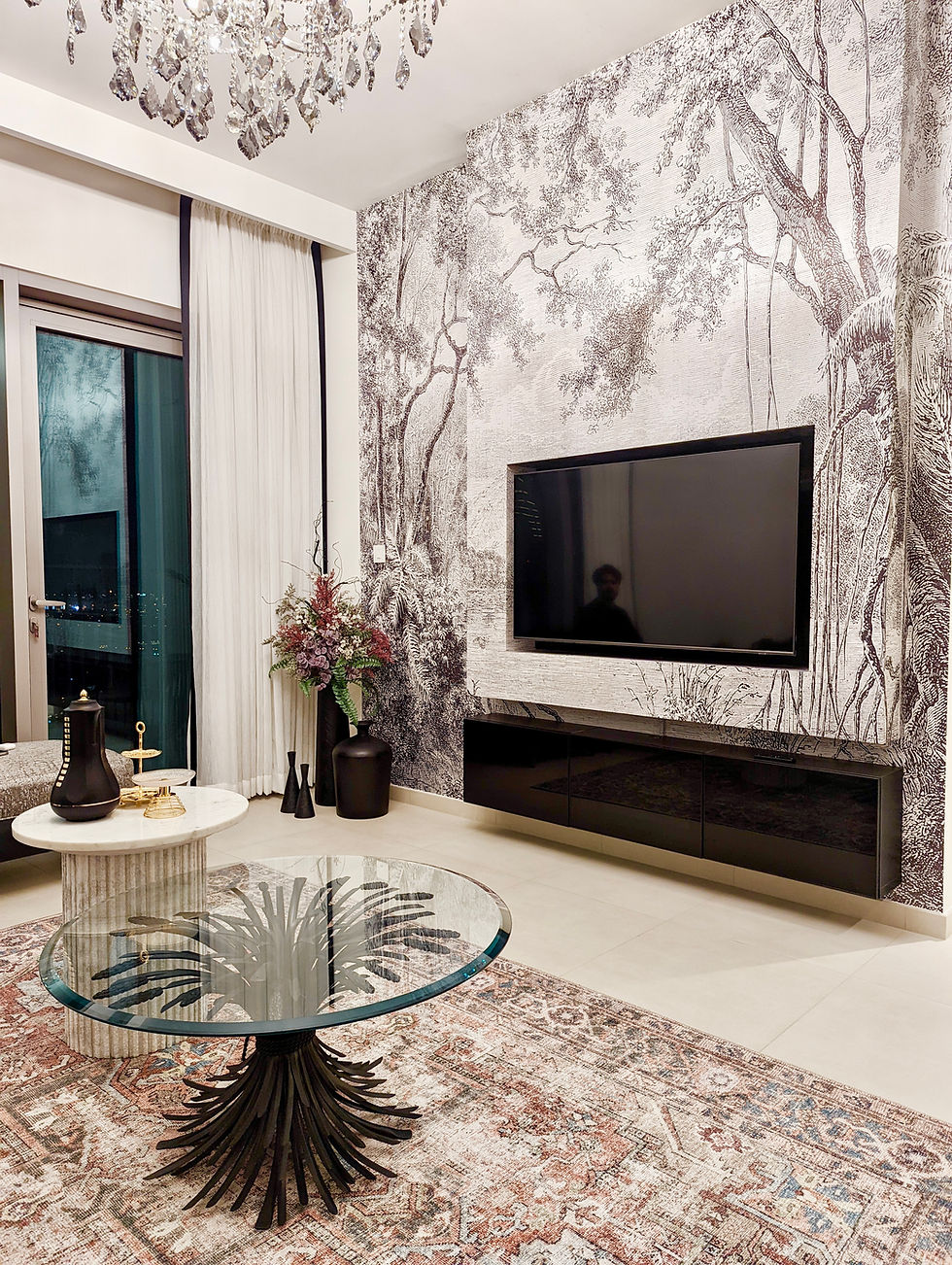
Image Credit: Designed by Naima Khan Design
That distinction has shaped every project I have taken on across twenty-five years of practice — in the UAE, across the Gulf, in South Asia, the UK, and Europe. It is the reason this blog exists.
Beautiful Is Not Enough
Dubai has some of the most visually ambitious interiors in the world. The finishes are impeccable. The scale is extraordinary. And some of those rooms are quietly exhausting to live in.
I have walked into luxury villas and felt immediately, subtly wrong — not because anything was poorly executed, but because nothing had been designed with the nervous system in mind. The overhead lighting was cold and flat, the kind that keeps cortisol elevated long past the hour the body needs to begin winding down. Marble floors and bare walls turned every footstep and every conversation into an acoustic event. The furniture looked balanced in the floor plan and created no sense of shelter in the actual room.
These are not small errors. In a city where residents move between the physiological extremes of intense outdoor heat and aggressively air-conditioned interiors — often multiple times a day — the interior environment is not a neutral backdrop. It is an active participant in how you feel, how you sleep, how clearly you think, and how well you recover from the demands of an exceptionally fast-paced city.
What Wellness Interior Design Actually Means
The phrase has become one of the most overused in the industry. Used loosely, it means very little — a diffuser, some greenery, a neutral palette. Used precisely, it means something considerably more demanding.

Image Credit: Designed by Naima Khan Design
Genuine wellness interior design in Dubai and across the UAE requires understanding how the human nervous system responds to light, materials, proportion, acoustic environment, and spatial sequence. It requires climate intelligence — knowing that the materials, colours, and design strategies appropriate for a home in a cooler climate behave entirely differently here, where summer temperatures exceed 45 degrees, and UV intensity degrades surfaces within years.
It requires asking different questions at the start of every project.
Not — what should this room look like?
But — how will this room feel at seven in the morning?
How will it feel when someone arrives home tired at nine at night?
What will it ask of the body — and what will it give back?
These are the questions I bring to every brief. They shape every material I select, every lighting decision I make, every spatial choice from the front door inward.
What a Wellbeing-Led Home Actually Gives You
A room designed for genuine wellbeing does not perform it. It does not arrive with a checklist of wellness features. It simply holds you — without demanding your attention, without asking to be noticed.
You feel it first in the quality of light. Not the flat brightness of a standard overhead fixture, but layered warmth — a floor lamp casting a soft pool in one corner, a table lamp at eye level beside the sofa, the last of the evening sun filtered through linen sheers. Light that responds to the hour, the way natural light does, rather than holding the room in a single relentless state from morning to midnight.
You feel it in what your hand lands on. The linen of a cushion. The cool, slightly textured surface of an unglazed ceramic vessel. The warmth of untreated timber on a shelf edge. Materials chosen not for the photograph, but for the moment of contact — for how they feel when you are not thinking about how they look.
You feel it in the quiet. A room where the acoustic environment has been considered — where soft furnishings, rugs, and textile layers absorb sound rather than reflect it — produces a stillness that is difficult to describe until you have experienced it. Your voice does not echo. The room does not amplify. There is space to think.
You feel it in the breathing room. The corner that has not been filled. The surface is allowed to remain clear. The visual rest that comes from a room confident enough in its own proportions to leave some of itself unoccupied.
This is what I work toward in every home I design. Not a look. An experience. One that continues to serve the person inside it long after the renovation is finished and the photographer has packed up and left.
How This Shapes Every Decision
In my practice, well-being is not an add-on at the end of a project. It is the framework from which every decision is made.
Lighting is designed in layers from the very beginning — task, ambient, accent, and natural — because the single overhead fixture that dominates most homes is one of the most reliably disruptive things a room can contain. Warm, low, layered light in the evening is not a luxury consideration in Dubai. For a body moving between the intensity of the outdoor sun and a mechanically cooled interior all day, the quality of artificial light at home is a health decision.
Materials are assessed beyond their appearance. Before anything reaches a specification, I consider how it will feel to touch, how it will age in the Gulf climate, and what it may release into the shared air over time. Low-toxicity, VOC-conscious material selection is standard in my studio — not an optional upgrade. The air inside most homes is significantly more polluted than the air outside, and the materials we bring in are a primary reason why.
Acoustic comfort is designed in from the earliest stage. Hard floors, high ceilings, and glass-fronted living spaces — features common in Dubai apartments and villas — create an environment that becomes acoustically harsh without deliberate softening. Rugs, curtains, upholstered furniture, and textile layers are not decorative additions. They are the difference between a room that exhausts you and one that lets you settle.
Space planning begins with the human body, not the furniture plan. Every layout I develop starts with how a person actually moves — where they will naturally want to sit, what they will see from that position, whether the room offers both prospect and shelter — the deep human need to see across a space while feeling protected within it.
A space is actively protected in every project. The most difficult conversation I have with clients is rarely about what to choose — it is about what to leave out. A room with visual breathing space, with surfaces that are not entirely occupied, is a room that does not quietly exhaust the person living in it. This is not minimalism as an aesthetic. It is an understanding of how the visual field affects the nervous system.
The Question I Ask at the End of Every Project
Does this space genuinely support the life being lived inside it?
Not — does it photograph beautifully. Not — does it reflect the most current thinking in luxury interior design in the UAE. Not even — does the client love how it looks on the day of the handover.
All of those things matter. Beauty is not incidental to my work — it is central to it. But in my practice, beauty is never the destination. It is the means by which a deeper outcome is delivered.
The feedback I value most does not arrive on handover day. It comes months later — when a client mentions they sleep better in this room, that they find themselves choosing to spend time at home rather than going out, that something in the apartment feels different, and they are not entirely sure how to explain it.
That is what twenty-five years of wellness interior design has taught me to work toward. Not a room that earns its place in a magazine. A room that earns its place in a life.
The spaces that serve us best are rarely the ones designed to impress. They are the ones designed to hold — so quietly and so steadily that we almost forget to thank them.
→ The Calm Home · Design for the Five Senses · Colour Stories · Materials & Mindful Living · Living in Dubai · Design Guides
Comments